I found the texts in this class to be rather enjoyable, and thus, the class as a whole to be enjoyable. My favorite part however, was the final half, as we were studying Cien Años. There was so much to discover in this book. I feel, though we examined the themes in this novel extensively, we barely scratched the surface.
Regarding the other texts we studied, I felt that they were interesting to discuss, though not always interesting to read (I am thinking of Cumandá), and I would have liked to have studied Neruda more extensively as we didn't cover much poetry. Although, I know we did not have much time to fit everything in.
What I found most enjoyable was the approach the class took in surveying the texts, finding themes and analyzing them as well looking at certain aspects of human behavior and relationships between the characters and their roles as members in their families as well as the difference in the family units themselves. As well, I thought the blogs were a great part of the course and should be use in more classes. I think this is good way to first, make reflections on the texts we are studying etc, second, be able to go back and reread these reflections as a reminder of the thoughts we had along the way, and the third and most useful reason, to be able to peruse the ideas of your classmates in order to get a more full interpretation of the texts studied. I found this last reason to be most helpful as people brought up things I hadn't thought of, which encouraged me to go further in my analysis and challenged my ideas.
Showing posts with label span365. Show all posts
Showing posts with label span365. Show all posts
Monday, April 9, 2007

Sunday, March 25, 2007
100 years more
 warning: contains spoiler
Alas, I have finished, and I didn't want it to end.
I closed the covers of Cien Años and said goodbye to all the characters that I have grown to love. *sigh. I know that I have truly enjoyed a book when I am sad to finish it. Though as well, the ending is sad and tragic, especially the part where the ants carry off the dead newborn baby. Yikes. And those Beundía's, they sure can't stop falling into bed with each other. I wonder if it was a bit of a moral statement that the unbridled passion between Aureliano Babalonia and his aunt, Amaranta Ursula ended in the death of their pig-tailed newborn, not to mention the end of the whole town itself? The significance of Aureliano's last name I think plays into it a bit (as we discussed in class). It is interesting that the town went from it's origins of just a quiet place where the founders lived with hardly any access to the outside world, to a place of wars, commerce, whorehouses and a massacre (though, after writing whorehouses, I questioned whether it really belonged in the list as Marquez doesn't seem to have a real problem with whorehouses and puts them in almost every book; though, I'll leave it in anyways), mimicking Babylon somewhat (thanks to Mikael for filling me in on a more complete version of the story of Babylon). Though are the two punished for incest? They weren't aware that they were related. Maybe were they punished for being so madly in love? It seems to be more the trend in the novel. Those who fall madly in love are somehow punished. Starting with Aureliano and Remedios (who dies), Arcadio is killed after falling in love with Sofia de la Piedad, Meme is sent to a nunnery for falling for Mauricio, Pietro Crespi is punished twice over for his love of Rebeca and then Amaranta. I could go on, but you read the book. Just a thought, but I feel that the Buendía's were never destined for happiness and love, but for loneliness and solitude.
Sunday, March 18, 2007
characterization

I have been creating a list of character traits that go along with each character and their namesakes in order to keep them all straight in my head, and to see if certain personality traits are handed down from characters to their namesakes. This what I have come up with:
In the José Arcadio Buendía line:
José Arcadio Buendía is an inventor, careless in his dress, obsesses over his ideas and creations, takes an interest in his sons educations, is a careless dresser, unusually strong, clairvoyant and of course, goes crazy in the end and is tied to a tree in the backyard.
José Arcadio (married to Rebeca) is said to have his father's character (p.14), though, unlike his father, lacks imagination, he enjoys excess (drinks, gambles and sleeps with many women until he marries Rebeca) and is also unusually strong and dies young, shot in his own house.
Arcadio (son of Pilar and José Arcadio and Pilar) does not recieve the full name of his father because he is illegitimite, takes an interest in education like his grandfather, but unlike his father, also has tremendous hereditary strength and dies very young. After impregnating Sofia de la Piedad with the twins, José Arcadio Segundo and Aureliano Segundo and fathering Remedios the beauty, he faces a firing squad, and is killed.
Aureliano Segundo (son of Arcadio). I put him in the José Arcadio line because the wise Ursula suspects that, during their mischievous games of pretending to be the other, they became confused and never changed back to the other. He was also a big, burly and strong man like his grandfather and great grandfather, was excessive, also like his grandfather. He had a good sense of humor and was very lucky. He marries Fernanda and fathers José Arcadio, Ursula Amaranta, and Meme.
In the Aureliano line:
Colonel Aureliano Buendía (who marries the young Rebeca) is silent and withdrawn, thinner than the Arcadios, is clairvoyant like his father, very proud, intense, brave and doesn't have the capacity for love (as observed by Ursula). He dies of old age against the tree in the backyard.
Aureliano José follows his father to war and I think he doesn't return? If anyone remembers this, I am missing a characterization of this Aureliano.
The 17 Aurelianos have the same intensity as their father and the same eyes.
José Arcadio Segundo (who was probably born Aureliano Segundo) follows in his Great uncle's footsteps and organizes a strike against the banana company. He is also quiet and reserved like the Colonel and spends his later years locked in a room reading Melquíades writings, similar to the same obsession Aureliano had over his gold fish.
(their are two more Aureliano's but I haven't gotten that far yet. I will fill the rest in perhaps at a later date)
My conclusion then is that, there are definite personality traits that are handed down through the names. The first José Arcadio Buendía seems to hand down traits to both his sons, but then after that, the José Arcadios seem to be strong and burly and drawn to excess. And the Aurelianos are more reserved, thinner and more intense, but are driven to fight (for the war and strike) and are natural leaders. This seems to be the same with the women as well but I will end this here because I could go on for another hour or so I am sure of I wanted.
Sunday, March 11, 2007
Ancestry
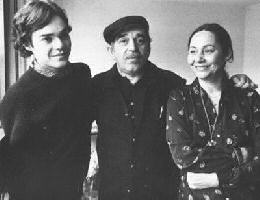
Reading Cien Años de Soledad. I started to wonder what Gabriel Garcia Marquez's family was like. I wondered how much of this book reflected his own ancestry, so I did a little investigating and I found a story of his parents meeting, which started with a beautiful description of his mother, and also gave some insight into the size of his family... "My mother became a woman in a godforsaken hellhole. She had spent an uncertain childhood plagued by malarial fevers, but, once cured, she was cured completely and forever, and with her health as strong as reinforced concrete she was able to celebrate her ninety-fifth birthday with eleven of her own children, and four of her husband's, and sixty-six grandchildren, seventy-three great-grandchildren, and five great-great-grandchildren. Not counting the ones nobody ever knew about" (Serenade: How my Father Won my Mother 2001 The New Yorker
As Marquez says, "Serenade" is about of how his parents came to be married and Love in the Times of Cholera is a based on his parents courtship. However, I did notice some similarities between his parents world and the world of the Buendía family:
First of all, like Ursula and José Arcadio Buendía, Marquez's mother's parents also moved away from a town due to her father having killed another man, "
I thought this quote about his own family was interesting and reflects a little on the Buendía family, "This atavistic prejudice, whose embers still linger, has turned us into a vast family of men with their flies open and unmarried women with numerous children in the street."
I also noticed that, in the Buendía family, most of the women are incredibly strong, especially Ursula and thought that this quote from "Serenade", about his mother, explains his the strength of character his females have in his novels. Here he describes his mothers sudden shift from daughter to a strong and wilfull woman "And she, who had been obedient and submissive, confronted her opponents with the ferocity of a lioness who has just given birth."
This quote reminded me of Amaranta's burnt hand, though it's not the same circumstances, they are very similar, "In the most corrosive of their many domestic disputes, Mina lost her temper and threatened her daughter with the bread knife. An impassive Luisa Santiaga stood her ground. Suddenly aware of the criminal implications of her wrath, Mina dropped the knife and screamed in horror, "Oh, my God!" And placed her hand on the hot coals of the stove in brutal repentance."
Marquez describes his father's mother, Argemira Garcia Paternina, and it reminded me of Pilar, (except for the physical description), "she was a slender white girl with a joyous nature and a free spirit, who went on to have six more children, by three different fathers."
And this quote reflects the politics of Cien Años, "The family's opposition to Gabriel Eligio was even more ferocious because he was an active Conservative, a member of the party against which Colonel Nicolás Márquez had fought his wars." This story can be found on this website, it's very good and if you have read Love in the Times of Cholera, you will probably see similarities between it and his parent's story as well: http://www.themodernword.com/gabo/gabo_serenade.html
Sunday, March 4, 2007
Cien Años de Soledad

This is one of my favorite books. I read it a couple of years ago and loved it and I am excited that we get to read it in Spanish. I really enjoyed the storyline about the gypsies who come to town and, though the story isn´t so much about the specific characters, but the several generations of a family and how the actions of one generation affects the younger generations (I think that's why Marquez gave everyone such similar names, making the characters personalities blur into one another, making it difficult to distinguish one character from another), I still enjoyed the stories of specific characters.
What I really appreciate about this epic work of fiction is the contrast of comedy and tragedy, which I think says something very profound about life in general. There is much to analyze here and I think a whole course could be spent on dissecting this novel. I know there are things that I am missing, such as the social/political comment being made by Marquez. I say this because, in my experience of Marquez'z work, there tends to be some sort of criticism of the social and/or political sphere but I would need to read more of the book to get an idea of what that is in Cien años de soledad. I am guessing it's more subtle for some reason or another. Maybe because I truly don't understand the culture because I am not part of it. Gender is another important theme in this novel. I think it would be easy to classify each person into stereotypes associated with their names... but I will think more on that and write on a later week. Though, I think the stereotypes work well in a book like this because it not necessarily about the individual but about the family as a whole.
Saturday, February 24, 2007
retrospection

Looking back through the texts that we have studied in the first half of the course I see several reoccurring themes: affection, desire, the indigenous perspective, modernism and genre are among those we discussed. The unifying thread between the works that we have been surveying is, mainly, families (with perhaps the exception of Neruda).
We have encountered several different types of families. In Cumandá, Mera focused on themes including the indigenous perspective, affection, poets, customs, death, desire, nature etc. Though I would say that the theme of the family was constant throughout his story. In Cumandá, the colonist family was broken; separated by tragedy, leaving only son and father. There was also an inspection of the Native family, their customs and their close connection with nature. Within these families there was a bond so strong that it brought both Cumandá and Carlos together and inexplicably drawn to each other, which resulted in the altruistic act of Cumandá's self-sacrifice in order to safe her lover/brother.
Neruda's poetry doesn't necessarily touch on the theme of family, but we still encountered some of the reoccurring themes of desire, affection, the poet, and invention/creation. Though they are different genre's there is still these common threads between Mera's work and Neruda's (also, though Mera's work was a novella, it did contain poetry).
Next, we read Las Memoria's de Mama Blanca, by de la Parra. Again, we see the importance of the theme of families in Latin American literature. This family though, differs greatly from the family in Cumandá. Blanca Nieves family was, through the eyes of Blanca, dominated by the feminine and the only male member of the family took a diminutive role, barking from his office window or scolding the workers from his symbolically higher position on the balcony. What I found interesting was this untouchability of what was masculine; the admiration and respect for male role models. Even Violeta, the "boyish" one of the sisters, was respected and admired, almost feared, by Blanca. As well, both Vicente Cochocho and cousin Juancho were revered by the girls. Their mother, the embodiment of femininity, appeared almost silly at times, especially when she was mocked by her husband for her attention to detail before her parties. Evelyn, the other important female role in the girls lives, was not revered, she was rather disliked and only listened too by the girls because she used force and harsh punishment (not such a feminine model but she was a women all the same). In sum, though the importance of the female role in this family was important, I found the male one equally as important through the admiration shown by the main narrator.
The family in Piedra Callada was again, a different family from the other books we discussed. This family was, at first, lacking a man, and when one was added, this male role model was an unfortunate addition who, in the end, was killed off by the grandmother. There were no characters to really sympathize with in this book, and as I said before, the picture painted of family life here was a bleak one. The children could have been sympathized with but their characters were, I am sure purposefully, rather undeveloped and mainly described as "los niños".
Lastly, we read Las Hortensias, a really odd book about a man who replaces his affection for his wife with his dolls. Main themes here are desire, industrialization, the artificial etc. The theme of family is an interesting one in this book because it is of an unconventional family. Maria can't have children (and it's probably good that she doesn't because her husband has an obvious mental imbalance) and she places her nurturing instinct on the doll. Her husband on the other hand, through his fear of losing his wife, focuses his desire less and less on his wife and more on the dolls, in the end replacing his affection for his wife with an affection for the artificial. What also makes them strange is their excessive lifestyle. I think excess could also be a theme of this book. For example, I am quite sure that it is extremely unusual in a country like Uruguay to have the means to hire a piano player to block out unwanted noise and to reconstruct a life size doll to make it feel warmer and more life-like.
Out of all the works we have studied my favorites are tied between Neruda's poetry and Mama Blanca's Memoirs. Las Hortensias is a close third. I think that is the use of imagery that I appreciate the most in these texts.
Sunday, February 11, 2007
Piedra Callada

Marta Brunet´s story, ¨Piedra Callada¨, is a rather bleak view of life. From the first page there is conflict between Esperanza and Eufrasia about Esperanza´s desire to marry Bernabé, a large, ugly beast of a man. When Esperanza marries Bernabé she is disowned by her mother, "Te podís casar cuando se te antoje: pero desde ese día no tenís más madre", and years pass when mother and daughter are estranged until she hears the terrible news that her daughter is ill. Another conflict ensues when Eufrasia arrives at her daughter´s home to care for the little ones and shortly after, Esperanza dies. There seems to be no actual reconciliation between the two and it seems, though Eufrasia has left her residence to care for Esperanza´s children, there is no verbal renege of the disownership and Esperanza dies, motherless, leaving her children in a similar state. Perhaps Esperanza´s death symbolizes the loss of hope.
The conflict becomes even bleaker when Bernabé beats both his children and their grandmother. Nature symbolizes the state of the family and the torment they suffer. Winter sets in, the grey clouds close in on the valley and it rains relentlessly, leaving the family isolated and trapped indoors. The sky clears when an argument is won by Eufrasia, and Bernabé leaves the house; but this is only temporary. He returns and the beatings continue. The sad story ends with a fishing excursion where Bernabé is hit in the head with a stone (the "silent stone" perhaps?) and the children return home without him. It is clearly stated what really happens to Bernabé after and there is a false sense of happiness; though it is false because there is no clear resolution and the grandmother leaves the door open for when Bernabé comes home, "abierta, porque para los otros el hombre todavía podía volver", which could be read as the foretelling of his return; though as Jon suggests, may tell us that the grandmother knows that he is not returning as she is the one who kills him, which then would make the story a little less than I had originally presumed and gives it a little bit of a happy(ish) ending.
Monday, February 5, 2007
Memorías de Mamá Blanca

Me gusta como de la Parra describe sus caracteres en su novela Memorias de Mamá Blanca por que usa muchos imágenes que son muy únicos; por ejemplo, cuando describiendo Vicente Cochocho escribe "Siendo casi del mundo de los vegetales, aceptaba sin quejarse las iniquidades de los hombres y las injucitias de la naturaleza. Hundido en la acequia o adherido a las lajas, zaheriéranlo o no, sequía como buen vegetal dando impasible sus frutas o sus flores" (145) o de Evelyn, dice “dentro de su corsé, bajo su rebelde pelo lanudo, algo reluciente y lo más liso posible, Evelyn exhalaba a todas horas orden, simetría, don de mando, y un tímido olor a aceite de coco. Sus pasos iban siempre escoltados o precedidos por unos suaves chss,chss, chss, que proclamaban en todos lados su amor al almidón su espíritu positiva adherido continuamente a la realidad como la ostra está adherida a la concha" (78). Pero, no entiendo por qué hay un narrador diferente al principio, no creo que era necesario para las historias de Mamá Blanca y siempre quería saber que paso al carácter que empiece el libro. También, los descripciones son muy complicados, a mí, me gusta buenos imágenes, pero en español hallía serlo muy difícil a leer y entender; a veces, no podía entender un entero frase. Aunque, disfrutí el libro.
Sunday, January 28, 2007
I like it when you shut up???
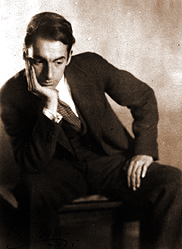
Mi favorito poema de Neruda de nuestro libro está “Me gustas cuando callas porque estás como ausente” porque cuando lo leí en español, creí que era sobre una situación muy común pero él diseca la situación en algo más sencillo. Pensí que cuando dice “Me gustas cuando callas porque estás como ausente” la mujer (quizá una novia) no está hablando a él problamente porque ella está enojado y por un momento es mejor que gritando. Pero al fin, dice que “distante y dolorosa como si hubieras muerto”, entonces la situación hace incómodo y lo ve la silencia como está mala; después dice “una palabra entonces, una sonrisa bastan” porque se gustaría que ella hable, casi negociando con ella por solo una palabra y una sonrisa. El último frase “Y estoy alegre, alegre de que no sea cierto” significa que el está alegre que ella no es muerte.
Pero a mí, es interesante que en inglés, lo leyera diferentemente. I read “I like you when you are silent because you are as though absent”, and I saw different images of what Neruda was trying to convey. I saw someone who was sad and wasn’t speaking because they were unable, choked up perhaps. “and you are like the word melancholy” stands out to me more in the English version. Of course, I understand English better than Spanish (though I enjoyed the poem better in Spanish than in English) and I imagine that because of this my interpretation of the Spanish version was probably wrong. My point being though, that translated, the poems meaning changes and certain things that are more significant in Spanish can sound less in English and vise-versa. What threw me off initially was the word “callas” in comparison to “silent”. I read callas to be something a little more malicious, like “I like it when you shut up because it’s like you’re absent” (haha, not quite as poetic as the translation). As you may well see, from that starting point, the poem takes on a whole new meaning.
I would like to know more about how other people interpreted this poem. Please share…
Pero a mí, es interesante que en inglés, lo leyera diferentemente. I read “I like you when you are silent because you are as though absent”, and I saw different images of what Neruda was trying to convey. I saw someone who was sad and wasn’t speaking because they were unable, choked up perhaps. “and you are like the word melancholy” stands out to me more in the English version. Of course, I understand English better than Spanish (though I enjoyed the poem better in Spanish than in English) and I imagine that because of this my interpretation of the Spanish version was probably wrong. My point being though, that translated, the poems meaning changes and certain things that are more significant in Spanish can sound less in English and vise-versa. What threw me off initially was the word “callas” in comparison to “silent”. I read callas to be something a little more malicious, like “I like it when you shut up because it’s like you’re absent” (haha, not quite as poetic as the translation). As you may well see, from that starting point, the poem takes on a whole new meaning.
I would like to know more about how other people interpreted this poem. Please share…
Monday, January 22, 2007
The END of Cumanda
(It's all English today folks, broken pc, using roomies laptop—which does not have a Spanish keyboard installed... excuses, excuses)
I must admit that the second half of Cumanda was easier to get through than the first half, probably because there was more dialogue and more action. I even began to enjoy it a bit.
I thought that that the plot took an interesting twist at the end with the death of Cumanda, though I believe it needed to happen. First, because I think that, for it’s time, the book was already controversial, being that it was about the forbidden love of a colonist with a “savage Amazonian head-huntress”, and that the twist was that Carlos and Cumanda were really brother and sister; but, how would the author be able to just end their feelings for each other without killing one of them. Their feelings for each other were so strong it wouldn’t have been believable if the passion was immediately extinguished. And it would have been too shocking if the characters ran off and fell in love anyways, or lived with their passions for each other, though ignored them. I don’t know if society would have accepted a book like that. Second, I believe that such a romantic book needed a dramatic ending. Everything was romanticized, from the flowers to the jungle, to the river, to the frogs mating, to the bonfire. In my opinion, a happy ending would have made it flat and redundant.
I also thought it was interesting that Cumanda was the most beautiful girl in all the tribes, and it turned out, she wasn’t even native. She was white and the most beautiful. Does anyone else find this to be an obvious bias? From what I understand, the author was trying to remain objective, was he not? And I understand that he was probably one of the more excepting people of other cultures and it was obvious that he admired the Indigenous culture, but, though we could excuse him for being a product of his own culture, I felt that the continuous name calling of the indigenous people as savage and barbaric made his attempt at enlightening the public of the indigenous ways, fall short.
I must admit that the second half of Cumanda was easier to get through than the first half, probably because there was more dialogue and more action. I even began to enjoy it a bit.
I thought that that the plot took an interesting twist at the end with the death of Cumanda, though I believe it needed to happen. First, because I think that, for it’s time, the book was already controversial, being that it was about the forbidden love of a colonist with a “savage Amazonian head-huntress”, and that the twist was that Carlos and Cumanda were really brother and sister; but, how would the author be able to just end their feelings for each other without killing one of them. Their feelings for each other were so strong it wouldn’t have been believable if the passion was immediately extinguished. And it would have been too shocking if the characters ran off and fell in love anyways, or lived with their passions for each other, though ignored them. I don’t know if society would have accepted a book like that. Second, I believe that such a romantic book needed a dramatic ending. Everything was romanticized, from the flowers to the jungle, to the river, to the frogs mating, to the bonfire. In my opinion, a happy ending would have made it flat and redundant.
I also thought it was interesting that Cumanda was the most beautiful girl in all the tribes, and it turned out, she wasn’t even native. She was white and the most beautiful. Does anyone else find this to be an obvious bias? From what I understand, the author was trying to remain objective, was he not? And I understand that he was probably one of the more excepting people of other cultures and it was obvious that he admired the Indigenous culture, but, though we could excuse him for being a product of his own culture, I felt that the continuous name calling of the indigenous people as savage and barbaric made his attempt at enlightening the public of the indigenous ways, fall short.
Sunday, January 14, 2007
Cumandá: 10 capitulos

Cuándo yo googled la palabra Cumandá, aprendí que es un lugar en Ecuador (según cabe suponer el lugar en el foto) y una planta que se usa como medicina. En el libro es el nombre de "la joven... que significa patillo blanco, la cual, no obstante su belleza, permananecía soltera" (102). Me pregunto si hay una significado entre los tres definiciones.
El primer capitulo era muy difícil a leer para mí porque hay muchos adjetivos nuevos que nunca he aprendida, los descripciones eran muy prolífico y a veces, podía ver lo que Mera describe. Creo que conocía la selva bien y quizá pasaba mucho tiempo allí. También, a través el resto de los capítulos, nunca paraba describiendo con mucha familiaridad y admiración a las caracteres, los marcos de la historia.
Una tema muy obvio es la tema de la familia. Para las caracteres parece que la familia es muy importante y el amor y devoción de esos caracteres es muy conmovedor y creo que es una de la más importante partes de la historia de Mera. La historia es sobre un amor tabú entre Cumandá y Carlos, los dos de culturas muy diferente entonces, la historia, asimismo es del amor prohibido
y las dos culturas. Parece que Mera hace comentarios sobre como es posible que dos culturas muy diferentes pueden (o no pueden) vivir juntos y los problemas que puede causar.
Tuesday, January 9, 2007
literatura y la familia
Lo que es más interesante sobre las familias en literatura es que son reflejos de las familias en realidad; aunque, hay diferencias también. Por ejemplo, en la historia de Marquez, "Cien años de soledad", la familia es familiar por que todos tienen lineas ancestrales y muchas historias sobre las personas en sus familias, pero, claro en "Cien años de soledad", hay realismo mágico que es fantástico y asimismo, personas que no todos pueden relatar... pero, esto no es interesante al fin y al cabo.
A mí, lo que es más interesante es las familias de los otros países. Acabo leer un libro se llama "The Moonlit Cage", por LInda Holeman y No es lo más mejor libro que he leído pero es muy interesante por que es sobre la vida de una mujer de Afganistán. Su familia era muy interesante por que era muy diferente de mi familia o las familias de mis amigos. Creo que es por que las expectaciones de las mujeres son muy diferente allí, entonces sus relaciones con su madre y padre eran menos abierto que mis relaciones con mi madre y padre.
Entonces, a mi, lo que es más interesante sobre las familias en literatura es las diferencias, y puedo ver estas diferencias en la literatura sobre culturas diferentes.

A mí, lo que es más interesante es las familias de los otros países. Acabo leer un libro se llama "The Moonlit Cage", por LInda Holeman y No es lo más mejor libro que he leído pero es muy interesante por que es sobre la vida de una mujer de Afganistán. Su familia era muy interesante por que era muy diferente de mi familia o las familias de mis amigos. Creo que es por que las expectaciones de las mujeres son muy diferente allí, entonces sus relaciones con su madre y padre eran menos abierto que mis relaciones con mi madre y padre.
Entonces, a mi, lo que es más interesante sobre las familias en literatura es las diferencias, y puedo ver estas diferencias en la literatura sobre culturas diferentes.

Subscribe to:
Posts (Atom)